

The 2026 legislative session delivered a lighter wage-and-hour year, but a landmark one. California is now the first state with statutes governing AI-driven discipline and termination, emotion-recognition tools, AI-caused layoffs, and attorneys' use of generative AI in practice.
Most updates take effect January 1, 2027, with some phasing in through 2028. This update also covers rate changes, earlier-enacted laws with 2027 deadlines, key vetoes, litigation to watch, and AI developments affecting attorneys' own practice.
California employers should assess how these developments affect their policies, notices, and workplace practices. The updates below are organized by topic, with key takeaways listed for each.
As always, Clarus is ready to work with you to develop compliance checklists, revised policy templates, and workforce communication strategies. Whether it's a customized briefing or workplace audit (in English and/or Spanish), we're here to ensure you're in compliance with these legal updates.
KEY NEW EMPLOYMENT LAW UPDATES
1. California Minimum Wage (Labor Code § 1182.12)
Starting January 1, 2027, the statewide minimum wage rises from $16.90 to $17.40 per hour for all employers, regardless of business size. This change impacts exempt employee classifications, wage-related premiums, sick leave accruals, and even wage statement compliance. For example, this wage increase will affect premium pay calculations for split shifts, reporting time, and meal/rest period violations.
With this new minimum wage, the minimum salary threshold for an exempt employee will be $72,384 per year.
More than 30 cities and counties are also adjusting their minimum wage much higher than the state rate. Many cities and counties adjust their minimum wage in July each year.* For that reason, the chart below reflects the applicable minimum wage rates starting on January 1, 2027.
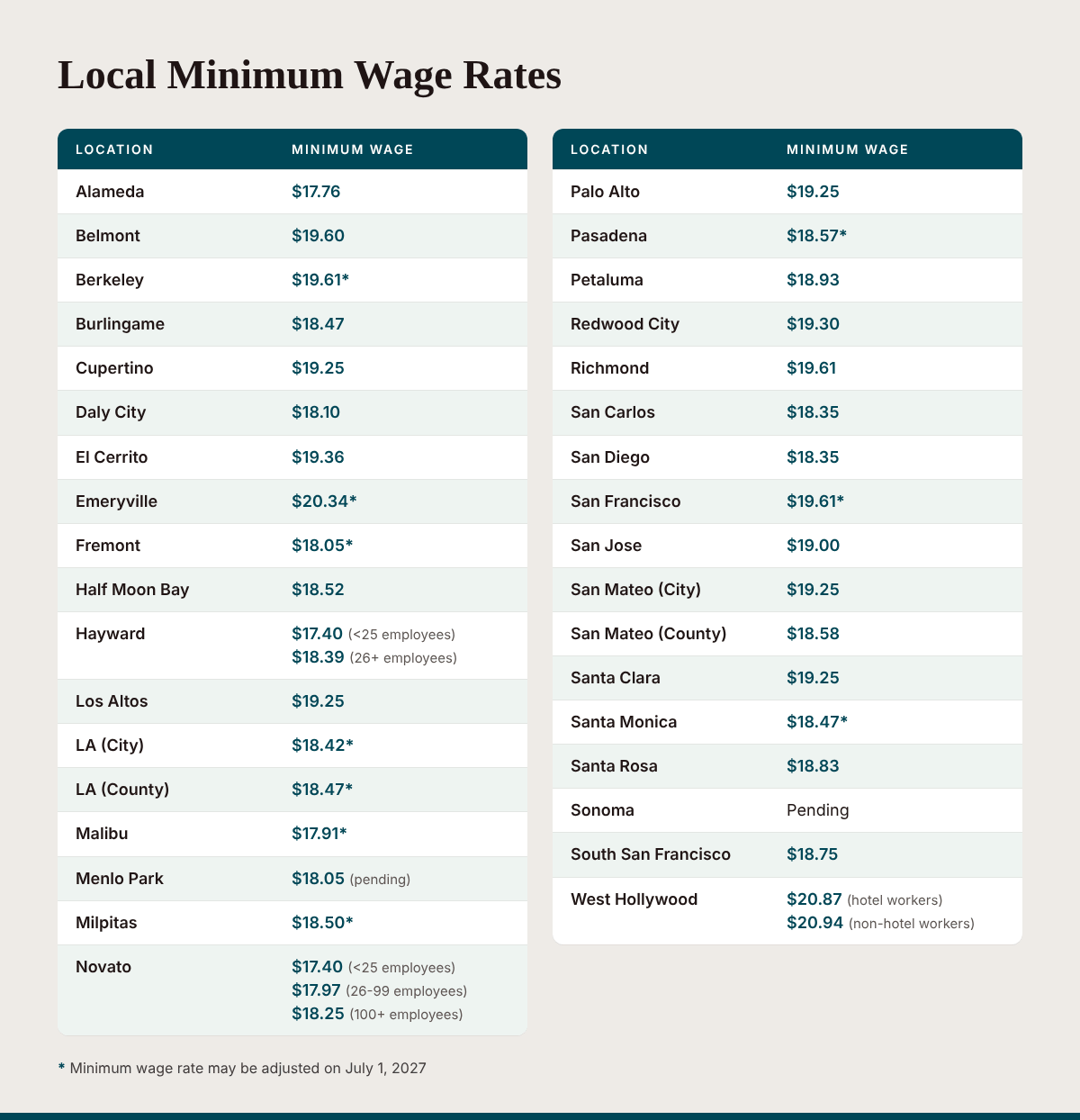
Takeaway: Audit pay for non-exempt and exempt employees, update payroll, piece-rate and commission floors, and split-shift calculations, and replace minimum wage postings. Raise exempt salaries or reclassify before January 1; the duties test still applies.
2. California’s Arbitration Act Aligns with Federal Law (AB 2155)
AB 2155 amends the California Arbitration Act (“CAA”) to provide that an arbitration agreement is unenforceable under state law to the extent it would be unenforceable under the Federal Arbitration Act (“FAA”). This eliminates the common fallback to state law for transportation workers exempt under the FAA and makes pre-dispute agreements covering sexual harassment and sexual assault disputes (under the federal EFAA) unenforceable under state law as well.
Takeaway: Review your arbitration agreements, especially for any workforce that may fall within the FAA’s transportation-worker exemption. Litigators should think twice before relying on the CAA as an alternative enforcement path where the FAA would not compel arbitration.
3. California Delays and Softens Its “Stay-or-Pay” Ban (AB 1697)
Last year, California passed AB 692. It bans “stay-or-pay” terms in employment contracts, meaning terms that make an employee pay the employer back for leaving the job. Common examples are repaying a sign-on bonus or training costs after quitting.
The ban was set to apply to contracts signed on or after January 1, 2026. Employers who violate it face actual damages or $5,000 per employee, whichever is greater, plus attorney’s fees. Employees can also sue on behalf of other affected workers.
What AB 1697 changes
The ban starts a year later. AB 692 now applies only to contracts signed on or after January 1, 2027. Employers face no liability for agreements signed during 2026, and pending claims based on 2026 conduct are moot.
Repayable bonuses are no longer limited to sign-on bonuses. Employers can now attach repayment terms to retention bonuses paid at any point during employment. The same conditions that applied to sign-on bonuses still apply, and all of them must be met:
The repayment terms are in a separate agreement, not the employment contract.
The employee is told they may consult an attorney and gets at least 5 business days to do so before signing.
No interest is charged.
Repayment is prorated over the retention period.
The retention period is no longer than 2 years.
The employee can choose to defer receiving the bonus until the end of the retention period. If they do, they owe nothing back.
Repayment applies only if the employee quits or is fired for misconduct. A layoff or termination without cause does not trigger repayment.
Advanced PTO can now be recovered. If you let an employee take PTO before they earn it, you can recover it when they quit, if:
The repayment terms are in a separate document provided when the employee asks for the advance.
Repayment is capped at 40 hours of PTO.
No interest is charged.
The employee left voluntarily.
Financial services firms get their own exception. Broker-dealers, investment advisers, insurance producers, and their licensed representatives can use repayable recruiting and retention payments under separate, more flexible rules.
Takeaway: Use the rest of this year to rebuild your templates before the ban takes effect on January 1, 2027. Review sign-on and retention bonus agreements, tuition repayment agreements, and PTO advance policies. Any repayment term in an agreement signed in 2027 or later must fit an exception. If it doesn’t, it’s unenforceable and creates penalty exposure.
4. Bereavement Leave for a “Designated Person” (SB 1149)
SB 1149 extends bereavement leave to a “designated person.” A designated person is someone related by blood or whose association with the employee is equivalent to a family relationship. Employers still must provide up to a five-day leave per death but may limit leave for designated persons to one occurrence in any 12-month period. Leave remains unpaid unless the employer provides otherwise, but employees may use accrued paid leave.
Takeaway: Update your bereavement leave policy and handbook to add designated persons, and decide whether you’ll apply the one-per-year limit for them. Train HR and managers to handle these requests consistently and without retaliation.
5. Discrimination and Retaliation Updates (AB 2563; AB 2495)
California law already bans discrimination based on sex. AB 2563 spells out that this includes treating someone differently because they don’t fit traditional ideas of how a man or woman should look or act.
Examples of what this covers:
Criticizing a woman for being “too aggressive” when the same behavior is praised in men.
Mocking a man for being “not masculine enough.”
Dress or grooming rules that require employees to look a certain way based on their sex.
The protection applies whether the trait is real or only perceived. It also applies to every California law that bans sex or gender discrimination, not just the main employment statute.
6. Stronger protection against immigration-related retaliation (AB 2495)
California already bars employers from retaliating against employees because of their immigration status. AB 2495 expands that protection. Employers cannot:
Take action against an employee because of their actual or suspected immigration status.
Use immigration-related threats to stop employees from asserting their workplace rights, such as complaining about unpaid wages or unsafe conditions. Threatening to call immigration authorities is the classic example.
Takeaway: Train managers never to raise immigration status during a workplace dispute and send any immigration questions to HR or counsel.
7. Harassment Training Must Address Hate Speech (AB 1803)
Effective January 1, 2028, mandatory harassment prevention training (employers with 5+ employees) must add guidance on recognizing, reporting, and responding to workplace speech that vilifies, humiliates, or incites hatred based on FEHA-protected characteristics.
Takeaway: Ask your training provider to add hate speech content to your harassment preventions training before 2028.
8. Pay Data Reporting (SB 1237; SB 464)
SB 1237 raises the maximum penalty for a subsequent failure to file the annual pay data report from $200 to $1,000 per employee. Under SB 464, courts must impose penalties when CRD requests them, and beginning January 1, 2027, job categories expand from 10 to 23 categories aligned with the federal Standard Occupational Classification system.
Takeaway: Confirm reporting responsibility and calendar the May 12, 2027, deadline.
9. Ignoring a Labor Commissioner Records Request Can Cost You Your Defense (AB 1316)
The Labor Commissioner investigates wage claims and other workplace complaints. As part of an investigation, it can send the employer a written request for records such as payroll, timecards, and personnel files.
AB 1316 raises the stakes for not responding.
If you don’t produce the records, you can’t use them later. Say the Labor Commissioner asks for your payroll records, you don’t send them, and you’re later cited. You then appeal the citation. You can’t use those payroll records to defend yourself, even if they would prove you paid correctly.
This rule already applied to some citations. AB 1316 extends it to:
- Citations from retaliation and discrimination complaints.
- Hearings on public works projects, where the Labor Commissioner assesses unpaid prevailing wages.
Judgments can follow you longer. If the Labor Commissioner wins a judgment against an employer, it can place a lien on the employer’s real estate. That lien can now be renewed for additional 10-year periods. An unpaid judgment won’t simply expire.
Takeaway: Treat every Labor Commissioner records request as a hard deadline. Produce complete records on time, or you may lose the ability to use them in your defense.
10. Misclassified Workers Can Now Sue for Penalties Directly (SB 1444)
Treating an employee as an independent contractor on purpose (“willful misclassification”) already carries penalties of $5,000 to $25,000 per violation. Until now, only the state could collect them. Now the worker can sue for those penalties too, along with the Labor Commissioner and public prosecutors.
Takeaway: Re-check every independent contractor relationship, because workers can now pursue these penalties themselves.
11. Cal/OSHA Criminal Enforcement (AB 2321)
Effective January 1, 2027, willfully obstructing a Cal/OSHA investigation becomes a misdemeanor, and the willful-violation crime now extends to serious injury, illness, or exposure. The Bureau of Investigations must investigate serious incidents tied to willful citations, and the Division must notify prosecutors of incidents involving 5+ employees, a death, or a prosecution request. The accident-reporting duty now includes “serious exposures.”
Takeaway: Update incident-reporting procedures to include serious exposures, train site leaders on inspection conduct, and involve counsel early on any willful citation.
12. Workplace Violence Restraining Orders (AB 1961; AB 2179)
Under AB 1961, when harassment, violence, or a credible threat is directed at a workplace or location, an employer may seek a restraining order protecting all employees at that location without naming an individual employee. AB 2179 will allow parties and witnesses to appear remotely at no fee and require courts to accept electronic filings beginning in 2028.
Takeaway: Add location-wide restraining orders to the response options in each SB 553 Workplace Violence Prevention Plan.
AI AND WORKPLACE TECHNOLOGY LAW UPDATES
1. California’s “No Robo Bosses Act” (SB 947)
Starting July 1, 2027, employers can’t discipline or fire an employee based only on what an AI tool or automated system says. A person must independently confirm the decision. The employer must also give the employee written notice and, if the employee asks, explain what data the system used.
Takeaway: Inventory your AI and automated HR tools, flag any that feed into discipline or termination decisions, and set up a documented human-review process for those decisions. Prepare a template post-decision notice and a process for answering employee data requests, and train managers and HR so the human review is real, not a rubber stamp.
2. Monitoring Employees: What’s Off-Limits (AB 1331; AB 1883)
Starting January 1, 2027, two new laws limit how employers can monitor employees:
AB 1331 bans cameras, audio recording, location tracking, and similar monitoring in workplace bathrooms, with narrow exceptions for safety and identification.
AB 1883 bans using AI to read or predict employees’ emotions, and bans collecting “neural data,” meaning information about brain activity gathered through devices like headsets or wearables.
Takeaway: List every tool you use to monitor employees, ask your vendors what data those tools collect, and turn off anything that crosses these lines.
3. AI-Related Layoffs (SB 951)
Under SB 951, if a mass layoff, relocation, or closure under Cal/WARN is caused in whole or substantial part by AI or automation, the notice must say so. It must be labeled a “technology displacement” notice and list the job functions being automated and the type of technology involved.
Takeaway: Build AI-causation analysis into RIF planning and privileged decision memos. If you’re planning reductions tied to automation, involve counsel early and update your Cal/WARN notice templates.
4. Expanded CCPA Deletion Rights (SB 923)
California’s privacy law lets employees and job applicants ask an employer to delete their personal information. Starting January 1, 2027, that right covers information collected about them from other sources, not just information they gave you directly. That includes data from background check companies, recruiters, and HR software vendors.
Takeaway: Make sure your process for handling deletion requests can reach data held by your vendors, not just your own files.
5. Using Employees In Your Marketing (SB 1111)
California law bars using a person’s image or voice in advertising without consent. SB 1111 makes clear this covers AI-generated copies of a person’s voice or appearance. It also removes a legal assumption that used to protect employers when an employee appeared in an ad only in the background.
Takeaway: Get written consent before using any employee’s image, voice, or AI likeness in marketing, and update your media release forms.
KEY VETOES WORTH NOTING
1. Menopause as a FEHA Protection (AB 1940)
This bill would have added perimenopause, menopause, and post-menopause to FEHA's definition of “sex,” with accommodation duties. Vetoed as likely to increase litigation without meaningfully increasing protections already available under existing law.
2. Hotel Notice Of Immigration Agents (AB 2721)
This bill would have required hotels to notify workers and guests when ICE or CBP agents have reservations. Vetoed over consumer privacy and public safety concerns; the Governor invited the Legislature to revisit it.
3. Union Notice Before Public Employer AI Adoption (AB 2656)
This bill would have required 45 days' notice to unions before public employers deploy generative AI on bargaining-unit work. Vetoed as adding “redundant administrative layers”; issues are best resolved through bargaining.
BILLS ON STANDBY
1. Captive Audience Meeting Ban (SB 399)
Preliminarily enjoined by the Eastern District of California in fall 2025 on First Amendment and NLRA preemption grounds. The Ninth Circuit heard argument on July 7, 2026 (Cal. Chamber of Commerce v. Bonta; California Policy Center v. Garcia-Brower).
2. PERB Jurisdiction Over Private-Sector Labor Disputes (AB 288)
Preliminarily enjoined as to NLRA-covered private employers on December 26, 2025 (NLRB v. California, E.D. Cal.). Public-sector PERB authority and the ALRB precedent amendment are unaffected.
RELEVANT CASE LAW
1. Fuentes v. Empire Nissan, Inc. (2026) 19 Cal.5th 93: Tiny or illegible print is a procedural (not substantive) unconscionability factor, but high procedural unconscionability requires close scrutiny of terms without a pro-arbitration presumption.
Takeaway: Reformat arbitration agreements for legibility.
2. Paknad v. Superior Court (2026) 119 Cal.App.5th 1256: An employer that asserts an avoidable-consequences defense or touts its outside investigation's thoroughness waives privilege and work product over the investigator's findings and related materials.
Takeaway: Separate the investigator role from remediation advice and assume notes may be discoverable.
3. Doe v. Wells Fargo Bank (2d Dist., Oct. 5, 2026) 2026 WL 2982155: For FEHA strict liability, a “supervisor” must have supervisory authority over the victim, though not necessarily as the direct supervisor.
4. Chaudhry v. State of California (2026) 123 Cal.App.5th 690: No individual supervisor liability for retaliation under Lab. Code § 1102.5.
5. Leeper v. Shipt (S289305) – pending: California Supreme Court argument set for November 3, 2026 on “headless” PAGA claims.
Clarus is ready to work with you to develop compliance checklists, revised policy templates, and workforce communication strategies. Whether it's a customized briefing or workplace audit, we're here to ensure you're in compliance with these legal updates.
KEY TAKEAWAY
The most effective compliance strategy is a proactive one. By reviewing the coming changes now and making thoughtful updates to policies and practices, employers can enter 2027 with confidence instead of uncertainty.